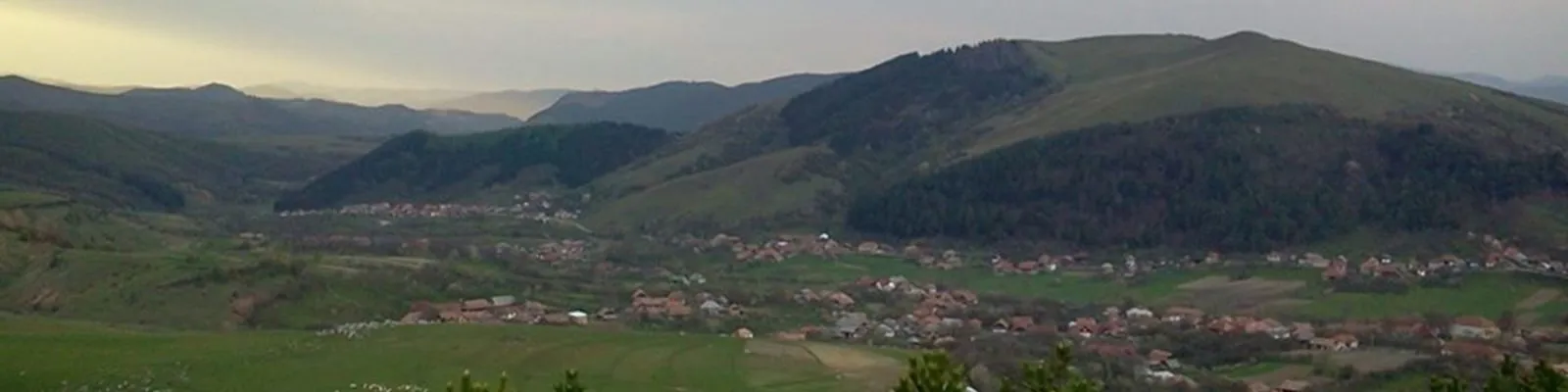
The Orthodox Monastery of Morlaca
 In the medieval period, between the 16th and 18th centuries, an Orthodox monastery also stood on the territory of the village of Morlaca, high up on Măgura Hill. Its site has remained firmly imprinted in the memory of the locals through the place name "La Brazii Mănăstirii" (At the Monastery Firs).
The Orthodox monastery of Morlaca was first mentioned in 1600, but its age is certainly much greater. In fact, in the Huedin area only five monasteries are mentioned in the 18th century (located in the villages of Morlaca, Berindu, Buteni, Cutiș and Stobor), of which only the first three were attached to the Romanian Orthodox Archpriestship of Huedin. [more here]
In 1731, the monastery of Morlaca was headed by the hegumen (abbot) Victor, and it received from several boyars a Triodion printed in 1725, during the reign of Voivode Nicolae Alexandru Mavrocordat, with the blessing of the Metropolitan of Ungrovlachia, Kir Daniil. On it one could read, in beautiful lettering, the following note, written by a monk of the Morlaca monastery:
"This holy book, namely the Triodion, was bought (?) for the holy monastery by the honourable boyars: Pop Janoș, captain, Dumitru Hodnojul Brașovan, Ioan Stoica Straja, Maște Simion, Ioachim Codraș, Sanduci Dribolocea, and they gave it to the holy monastery of Morlaca as an alms for the souls of the dead; and whoever should happen to take it (?), or sell it, or steal it, or keep it for his own use, let that man be cursed, damned, accursed and thrice accursed, anathema maranatha, by the Father and by the Son and by the Holy Spirit and by the 318 holy Fathers of Nicaea, and may his soul have no part with the righteous but with Judas, who sold Christ, and with Arius the blasphemer of the Godhead, and with the other sinners. Written by me, Hieromonk Victor, in the year from the Creation 7239, of the Lord Christ 1731." [more here], noting that the article confuses two monasteries of that time, which is why only the last part of the article, about the Morlaca Monastery, has been corrected]
At that time, the monastery owned "a plot within the village of 40 by 35 fathoms of land, hayfields yielding 3 cartloads of hay, and arable land sown with one bucket of wheat, as well as forest." Half a decade later, however, between 1772 and 1774, owing to the persecution launched in those times against Orthodox believers, priests and monks, the monastery was left without any monks. A few years later, a canonical inspection report by Bishop Grigore Maior states that part of the monastery's orchard had been taken over by two serfs of Count Gheorghe Banffy. [more here, p. 31 and here, p. 70]
It is worth mentioning that the Morlaca Monastery is recorded at the end of the 18th century as a monastery-school, which shows that a school also operated for a long time within the monastery grounds. The document proving this fact is a reply sent on 11 February 1783 by the archpriest of Turda, Teodor Meheși, to a letter from Bishop Ioan Bob, who had asked for his opinion on the monasteries that were to be kept for cultural purposes (schools). "Concerning the monastery of Morlaca, I wrote to Archpriest Daniil of Mărgău and to the others under his authority, and he has not sent me any reply; the one at Morlaca could be left for the school." [more here, p. 81 and here] We thus learn that at that time the monastery was under the jurisdiction of Archpriest Daniel Ungur of Mărgău, and that the archpriest of Turda, Teodor Meheși, proposed that the monastery of Morlaca be kept for the school run by the monks (at a time when a great many Orthodox monasteries had either been proposed for closure or already burned or demolished on the orders of General Nicolae Adolf, Baron von Buccow, in July 1761).
In the end, the church was sold to the village of Poieni and set up in its cemetery. In 1892 it was demolished and replaced with another, more durable one.
"Today the grass grows over its traces, as over the traces of so many others."
[Photo: The Morlaca Monastery from "Brazii Mănăstirii" (the Monastery Firs), moved to the Poieni cemetery in 1804 and demolished in 1892. Photograph taken in 1886]
Bibliography
- Various authors, Repertoriul Arheologic al judeţului Cluj (Archaeological Repertory of Cluj County), Ed. Muzeul de Istorie, Cluj-Napoca, 1992
- Codruţa Trană, Nuţu Moiş, Monografia comunei voivodale Călata, jud Cluj
- Nicolae Șteiu, Morlaca: Satul de la poala Măgurii (Morlaca: The Village at the Foot of Măgura), Casa de Editură Dokia, Cluj-Napoca, 2009
- Daniel Dumitran, Un timp al reformelor: Biserica Greco-Catolica din Transilvania sub conducerea episcopului Ioan Bob:
- Ana Potra, Organizarea şi evoluția şcolilor româneşti din zona Huedin pânã în 1867 (The Organisation and Development of Romanian Schools in the Huedin Area up to 1867), article published in the journal „Glasul”, no. 3-4 (78-79), 2003, p. 19.
0 comments