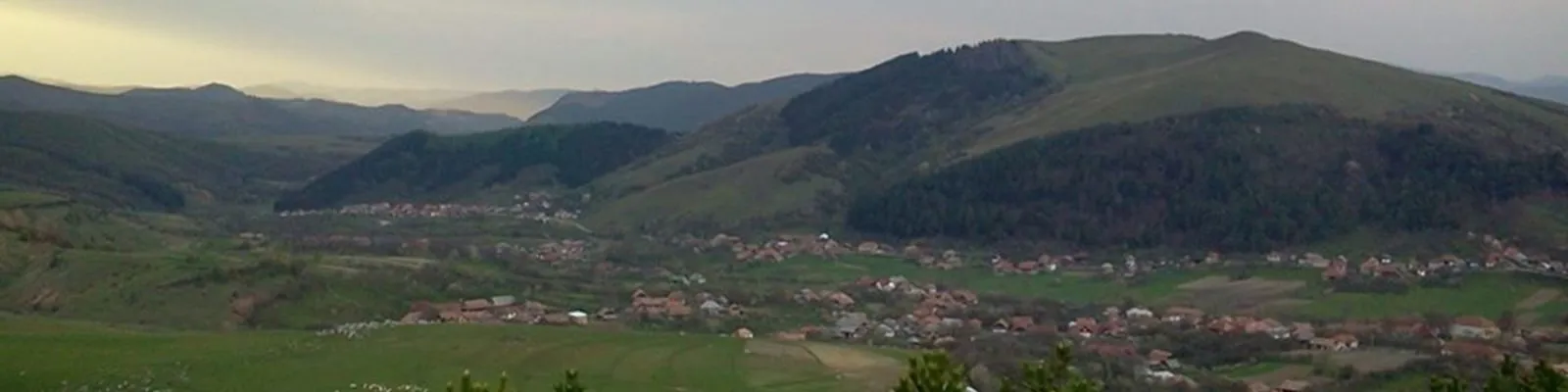
The Fossil Site of Morlaca, Poieni Commune
 Some 38-34 million years ago, on the land of today's Morlaca, in a tropical climate dominated by exotic members of the beech family, palm trees and mangroves, there lived animals long since extinct, such as titanotheres (Brachydiastematherium transilvanicum), amynodonts (Sharamynodon), anthracotheres (Prominatherium), crocodiles (Diplocynodon), turtles and others.
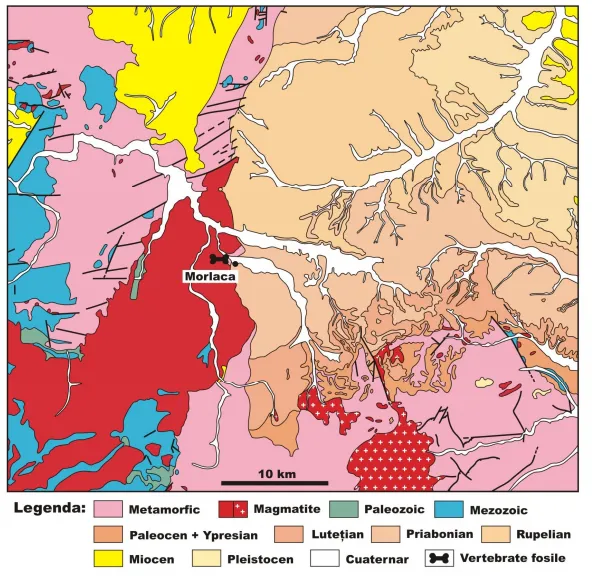
Today, Morlaca is one of the most important fossil sites in the north-west of the Transylvanian Basin, because a sequence of rock layers outcrops here, beginning with the Lower Eocene marine series and continuing up to the level of the Cluj Limestone Formation.
All the bones at Morlaca were found disarticulated and mostly fragmentary, which shows that they were carried by water and then deposited in the infill of one channel or of several overlapping channels.
Of particular importance is the discovery here of fossil remains of Brachydiastematherium transilvanicum, which lived in the Late Eocene, 38-34 million years ago. To date, its discovery at Morlaca is highly significant, coming a century after the species was first recorded (at Rădaia, near Cluj), a period during which no further fossil evidence of it had been found. The site is also special because, according to Cristina Fărcaș, it represents the first record of an amynodont in the Eocene of Transylvania and the first time these animals have been found together with an anthracothere. For this reason, Morlaca is one of the richest Eocene sites for large mammals, not only in Romania but in all of South-Eastern Europe.
As for the Eocene fossil flora of the area, it was studied by Petrescu and Givulescu in 1987 and is considered representative of north-western Transylvania. It was dominated by exotic Fagaceae of the Castanopsis type, along with palm trees or Nipa, which formed mesophytic forests, alongside landscapes of palm savanna or mangroves, in a "tropical-subtropical" climate with low rainfall. (Petrescu, 2003, p. 53). The average temperature was about 20-23 °C (maximum 27-28 °C, minimum -15 °C), and rainfall was around 1,200 mm a year (cf. Petrescu et Givulescu, 1987).
The site was first reported in 1915 by Szadeczky, and research continued with Mateescu (1926), Mészáros & Tămaș (1963), Petrescu & Mărgărit (1987), Mészáros et al. (2001) and Baciu (2003).
Map: Cristina Fărcaș, "A Study of the Terminal Eocene and Early Oligocene Continental Formations
in the NW of the Transylvanian Basin ..."
*Note! This text is based on the doctoral thesis of Cristina Fărcaș, "A Study of the Terminal Eocene and Early Oligocene Continental Formations in the NW of the Transylvanian Basin – Biostratigraphy and Palaeoenvironmental Reconstructions Based on Continental Vertebrate Assemblages" (original title: "Studiul Formațiunilor Continentale Eocen Terminale și Oligocen Timpurii din NV-ul Depresiunii Transilvaniei – Biostratigrafie și Reconstituiri Paleoambientale, pe Baza Asociațiilor de Vertebrate Continentale"), scientific supervisor: Prof. Dr. Vlad Codrea, Cluj-Napoca, 2011
0 comments