Traditional Folk Costume of Morlaca

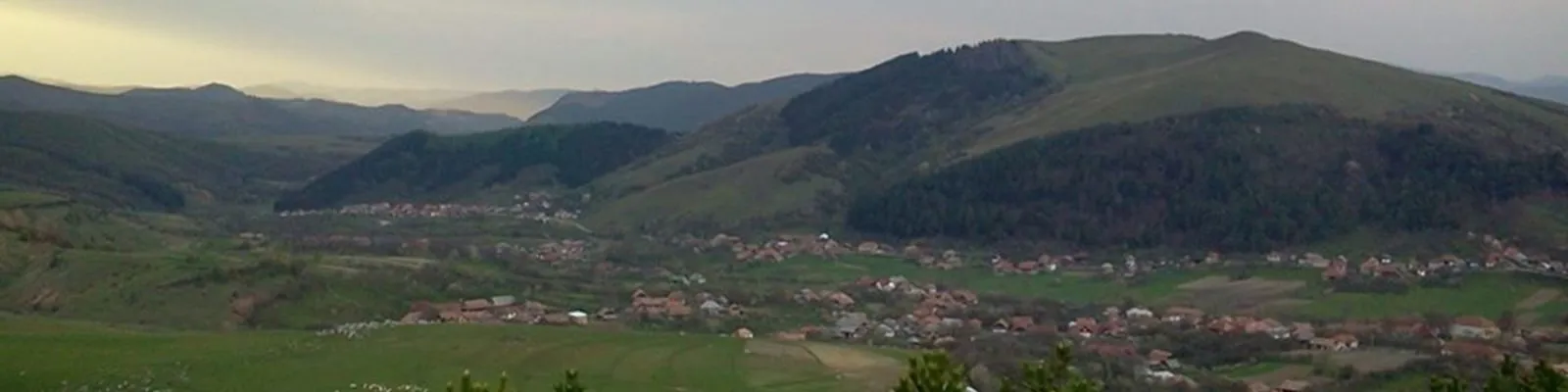
 The folk costume of the peasants of Morlaca belongs to the ethnographic area that takes in the villages of Alunișu, Călata, Călățele, Buteni, Ciuleni, Mărgău, Bologa, Fildurile, Răchițele and, with slight variations, Ciucea, Negreni and Bucea.
Women's costume
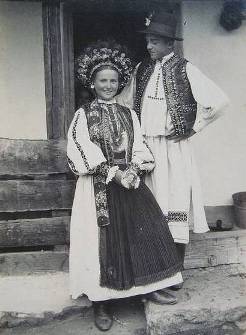 "The women's blouse, called the "cămeșe cu piept" and the "cămeșe cu ciupag" (the blouse with a gathered bodice), is usually embroidered in a single colour, with geometric motifs worked along the edges of the pleats and on the chest. At the neck, over the gathers at the front, there is a narrower band of embroidery. Threads are drawn through the sleeves, and the same technique was used for the "trasura" or cuff band, while the sleeves end in cipcă (lace edging). The body of the blouse was cut with a broad front from one and a half widths of cloth, and from the remaining half-width the small gussets and the underarm panels were cut. The body of the blouse is short, reaching only to the waist, where it is joined to the skirt. The cloth at the chest is drawn together into gathers, which form the ciupag. The upper gathers of the blouse are caught into a collar, sometimes embroidered all over, worn close around the neck. The decoration of the blouses differed with age: shades of red for girls and young women, and black for older women. [...] The sleeves and the ciupag on the chest are the most richly decorated parts of the blouse. [...] The poale (underskirt) was always white, cut separately from homespun hemp cloth that had been dipped in the stream many times and then laid out in the sun to bleach. [...] The underskirt has few ornaments: some simple cheițe-style joining stitches, an openwork called ciur îndărămnic, bocori and bunucăi. The widths of cloth were joined together with blind eyelet stitching called rupturi. Another important piece is the zadie cu trup vânăt (an apron with a dark blue body), once worn both in front and behind, leaving the underskirt visible, especially when walking. The zadie is rectangular, about 80 by 46 cm. The dark blue or black part is about 30 cm, the rest being an orange-red, decorated with narrow stripes and, between the stripes, small geometric motifs. In the second half of the last century the zadie was replaced by the șorț (apron). On the head women wore a cârpă albă (white headscarf) [...] or a black năframă (kerchief) with large tassels. On feast days, at weddings and at village dances, girls wore the muruna (a stiff-rimmed headdress sewn with small beads, little pieces of ribbon and geometric figures)."
Men's costume
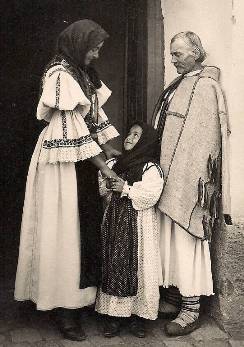 "The men's costume of Morlaca has fewer decorative elements. It consists of the shirt, gaci (wide linen trousers), short sheepskin vest, long sheepskin vest, suman (woollen coat), cioareci (woollen trousers), lambskin cap, hat, opinci (leather sandals) and, over the last century, boots. The old men's shirt was made from a straight cut, with a simple rectangular body in the middle of which the neck opening was made. The sleeves were made from rectangular pieces of cloth attached to the body at the level of the side gussets. The festive shirt had embroidery along the edge of the body, at the front as well as at the back and on the shoulders. On the sleeves, embroidery was worked alongside the seam and along the bottom edge. Most shirts had mâneci de pumnari (sleeves gathered into cuffs). The collar of the shirt was richly ornamented with tightly packed embroidered geometric figures and floral motifs, and more rarely with zoomorphic figures (usually birds). The gaci were made wide, from 4 to 6 panels of white cloth about 80 cm wide, joined together with white-thread cheițe stitches and hemmed with eyelet work called rupturi, or with small fringes made from unravelled threads. [...] The cioareci were made of white or grey cloth. They were decorated with riveted or lace-cut soft leather (irhă) ornaments, also on the pockets and in place of cuffs. [...] Over the shirt men wore the short vest, and in winter the long vest. These were made from gores, the winter ones being longer at the back to protect the lower back. The sumane were worn mostly over the vests in cold weather. They were made from five ells of homespun sheep's-wool cloth, dyed black and fulled in the fulling mill. [...] Men, especially on working days, wore frișuri, that is, short coats reaching just above the knee, made from a single piece over the back and chest and completed at the sides by the sleeves."
"On their feet they wore opinci of cowhide, made with a short gurgoi (pointed toe) of 3 cm and laces also of leather. As early as the first half of the 20th century, the opinci began to be replaced by boots."
Note: The passages above are taken from Nicolae Șteiu, Morlaca - satul de la poala Măgurii (Morlaca, the Village at the Foot of the Măgura), Casa de Editură Dokia, Cluj-Napoca, 2009, pp. 175-179.

0 comments