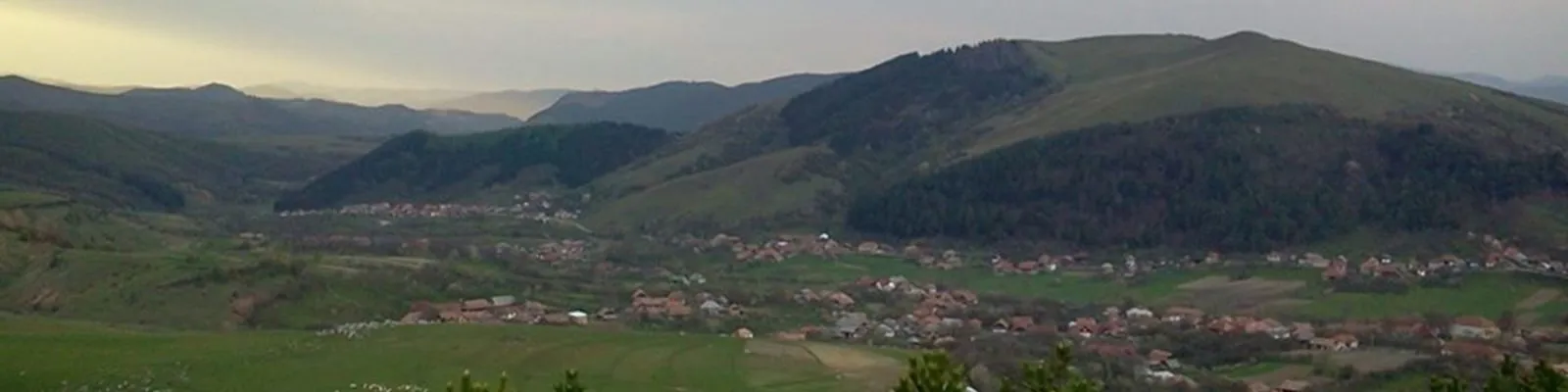
History of the Village

The territory of the village of Morlaca (Maróthlaka or Marótlaka) has been inhabited since the earliest times, and this settlement is one of the most significant in the commune of Poieni.
The Place Name Morlaca/Marothlaka
In the earliest documents, the village of Morlaca is recorded as Maróthlak – 1493, Possesiones Maróthonlak – 1519, Maróthlaka – 1666 and Maróthacz – 1762. The village's name can be linked to the name of Menumorut and that of his grandfather (Moruth, Maroth or Morut). Thus the name of the village, Maróthlaka, would come from joining the words "Maroth" (Maroth) and "Lak" ("house", "dwelling" in Hungarian), which would translate as "Maroth's dwelling", hence also the place name Maróthlak, and later Maróthlaka. It is worth mentioning that in the 9th–10th centuries the village of Morlaca belonged to the duchy of Menumorut. [more here, p. 104]
Here we recall the lines written in 1921 by Traian Șuteu, teacher in the village of Morlaca, delegate to the Great National Assembly of Alba Iulia of 1 December 1918 and also a member of the Great Romanian National Council: "Having thus come fortunately through all the overwhelming calamities, poor in wealth but still pure in soul, they begin to recover, to gather together in rank, so that when, between the waters of the Criș rivers, the rule of Lord Memmorot could take shape, it finds them worthy of raising among them: his summer residence. As proof, the old people can point out in the village a small lane which, together with two gardens beside it, was paved with river cobblestones. The soil of the place is clayey, and so the presence of the cobblestones cannot be explained as being part of that ground, other than that they were brought and laid there by human hands. Thus from the names Maroth and Lak which would mean Memmorat's dwelling the name Marothlak or Marothlaka would have been formed, and later it remained simply Marothlaka which was the official name. And in Romanian it is called: Morlaca." [more here, pp. 12-13]
Prehistory and Ancient History
The territory of the village of Morlaca has been inhabited since the earliest times. On the edge of the village, towards Bologa, in the place called Drumul găunos (the Hollow Road), Neolithic stone axes more than 4,000 years old have been discovered.
It is worth noting that more than a millennium and a half ago, in the triangle formed by Măgura Morlacii, Brăișoru and the Cluj–Oradea national road, there was a hamlet called Remetea or Rimetea, which history studies describe as a "village that has since disappeared". "The age of the settlement at Remetea is lost in the mists of time; it dates from roughly the same period as the Neolithic settlements at Huedin-Cetatea Veche, Călata and Bologa. Here, at Remetea, a plough iron from the Dacian period (probably La Tène) was discovered, but no archaeological excavations have been undertaken to take the research further. An octogenarian who worked at the Morlaca quarry told us that he knows the place where the church stood and where he saw the remains of its foundation, not far from the bend of the Crișul Repede river, while the village cemetery lay on the other side of today's highway, to the left of the road leading to Hodiș, where skeletons were found." [http://alunisu.simplesite.com/] Oral tradition says that the inhabitants of this hamlet withdrew before the Tatar-Mongol invasion of 1241–1242 to the present site of Aluniș and founded the nearby village of that name.
The area continued to be inhabited also by the Dacians, as the village's place names bear witness: "Măgura" (which in the Dacian language meant "prominence" or "mother of the heights"), "Muncei", "Runc", "Brădet" etc.
Following the two Daco-Roman wars (of 101-102 and 105-106 respectively), the territory of the village was part of the Roman Empire, lying very close to its borders. Indeed, there are numerous remains from the period of Roman rule in the area (106-271). Thus, in the neighbouring village of Bologa, in the Călata valley, in the place called Grădiște, the foundations of a Roman fort (known in its day as Resculum) are still preserved. As a place name, "Grădiște" usually designates the site of a fortress or citadel lying in ruins. The fort is the oldest Roman settlement in the area, built around the year 106 as the garrison of the Cohors II “Hispanorum”, whose mission was to defend the border of the Roman Empire. The Roman fort is one of the most important on the north-western limes of the Roman province of Dacia.
Of particular significance is the fact that the Roman road linking the border fort of Resculum with Gilău (and which then continued towards Napoca) crossed Morlaca's territory and ran through the villages of Călata, Văleni and Mănăstireni. This emerges from the letter of King Béla IV sent to the Chapter of Oradea on 1 May 1256, in which there is mention of "the customs post at Vadu Crișului and the road that connected the border fort of Resculum with the settlements: Călata, Văleni-Mănăstireni-Gilău, the old Roman road".
The territory of the village of Morlaca would remain under Roman rule until the withdrawal of the army and of the Roman administration (271 - 272). After the Aurelian withdrawal, the Romanized population continued to live in these lands, despite the migratory peoples that were to pass through here.
The Medieval Period
At the turn of the 9th and 10th centuries, the village of Morlaca was part of the voivodeship led by Menumorut/Menumorout.
The village of Morlaca was first mentioned in documents on 23 January 1399, when King Sigismund of Luxembourg gave Mircea the Elder (Mircea cel Bătrân) the Bologa fortress together with the surrounding villages, among which the village of Morlaca is also named.
In the medieval period, the history of Morlaca is closely bound up with that of the other settlements of the Călata land. Over time, this territory organized itself into independent "voivodeships", each headed by its own local leaders. Between 1369 and 1511, the village of Morlaca was part of the Voivodeship of Călata, together with 16 other villages: Brăișoru, Mesteacăn, Ciurea, Bica, Dretea, Izvorul Crișului, Huedin, Aluniș, Tetișu, Almașu, Babiu, Călata, Fildu de Jos, Fildu de Mijloc and Fildu de Sus. Thus, in the 15th-16th centuries, we know of the voivodes: Ilie of Călata, his son Mihai, Cândea of Oarța, Alexandru, Laslău, Sandrin and Andrei of Fild, Gheorghe of Mărcau, Petru, Bota Anton. Gradually, however, the voivodes kept only their titles and sank into the ranks of the peasantry, becoming village judges. [more here]
In 1435, the Bologa fortress with the villages belonging to its estate, Morlaca among them, was owned by the Banffy family of Losoncz. In 1493, the nobleman Nicolae Vaida of Morlaca is mentioned on the village's territory.
In 1666, historical documents speak of the voivode Pui Petru of Morlaca, who came into possession of some villages that had belonged to the estate of the Bologa fortress, which attests that the voivodal institution survived in the area until a late date. "The voivode Pui Petru of Morlaca was the leader of the voivodal circle that included: Morlaca, Brăișoru, Bologa, Fildu de Sus, Hodișu, Valea Drăganului, Săcuieu. In that year 17 serf households (porți) and 21 sons are recorded in Morlaca, while the neighbouring villages had less than half as many (Brăișoru - 7, Bologa - 5, Săcuieu - 8, Fildu de Sus - 7). At that time a serf household was reckoned at 10 persons, members able to work, while under "sons" were listed the adult but unmarried children of the serfs, so that they would not be subjected to serf obligations. [...] At Morlaca, the voivode Pui Petru had several duties: he coordinated the collection of the double census, one annual, called "the land toll", and the other "of the third year", nicknamed now "the whip tax", now "the smoke money". By around 1670 the voivode had been reduced to the status of a simple village judge, with limited authority, as he had become subservient to the nobleman. He was merely a slightly better-off farmer, with 2 cows, 2 oxen, 1 horse and 10 pigs." [Nicolae Șteiu, Morlaca: Satul de la poala Măgurii (Morlaca: The Village at the Foot of Măgura), p. 26].
At the end of the 18th century, in the geographical area between the Vlădeasa and Gilău Mountains, medieval documents mention the existence of a seat/district/land made up of two voivodeships: the first at Morgău, and the second at Călata, to which belonged the villages: Morlaca, the three Fildu villages, Mesteacăn, Ciucea, Dretea, Izvorul Crișului, Huedin, Remeș, Zam, Brăișor, Tetiș, Bahiu, Păniceni, Dumbrava and Nadeș. [Codruța Trană, Nuțu Moiș, Monografia comunei voivodale Călata, jud Cluj]
The village of Morlaca is mapped in detail on the Josephine Map of Transylvania from 1769 - 1773, on page 059. From it we learn that the village's first church (most probably built of wood, between 1724 and 1735) stood on the site of today's church. We also learn that the village church and the Orthodox monastery at Brazii Mănăstirii were linked by a country road. The topographic details also show that the village's first parish house did not stand where today's does, and that the village consisted of rather few households.
Places of Worship
a. The Orthodox Church in the Village
Oral sources tell us that in the 15th-16th centuries, the village of Morlaca had two churches and an Orthodox monastery. Tradition tells us that the first church of the settlement stood "La pietrii" (At the Stones) and that it was built of oak wood. It is said to have later been moved to the site of the present church in the village. The oral sources, however, also recall a story with a fairy-tale flavour. It is said that "the villagers, having resolved to move the village lower down, decided to be guided by the direction in which the first wood chip would fly. This is how they came to the site of the present church and, around it, of the village hearth" [Nicolae Șteiu, Morlaca: Satul de la poala Măgurii, p. 19].
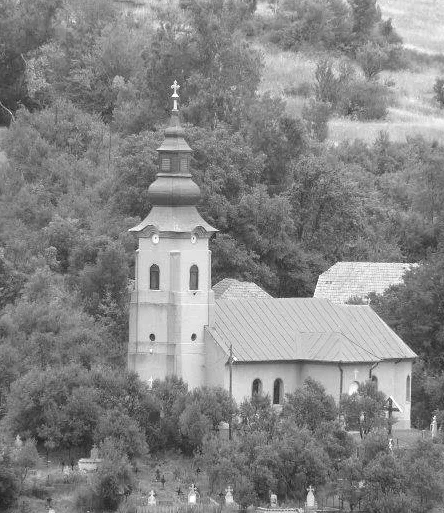
The Orthodox Church of Morlaca was built between 1837 and 1838, on the site of another, older wooden church, built - most probably - between 1724 and 1735.
Initially, the village priests followed the Orthodox, Eastern Christian rite, but for 200 years the Greek Catholic rite was also practised, as a result of the pressures and the policy of forced Catholicization carried out by the Hungarian rulers of that time. The transition from the Orthodox to the Greek Catholic rite took place in the second half of the 18th century. Thus, in 1733, in the village of Morlaca three priests were mentioned: Achim and Vasile and Vasile (probably father and son). Achim was the first to convert to Greek Catholicism, while the other two would remain faithful to the Orthodox faith. This led to an unusual situation: the Orthodox Parish of Morlaca belonged to the Archpriestship of Călata, while the Uniate one belonged to the Archdeaconate of Jucu de Jos. "Achim was succeeded by the Uniate priest Gherontie, who was also archpriest of the Morlaca District. [...] From the time of Father Achim's ministry until the end of the 18th century, the Christians of Morlaca went over to the Greek Catholic Church." [Nicolae Șteiu, Morlaca: Satul de la poala Măgurii, p. 76]. Interestingly, around 1886, documents of the time mention the Greek Catholic Archpriestship of Morlaca, which was led by Vice-Archpriest Analia Popu and which comprised 17 parishes in the surrounding villages, numbering 13,212 souls.
In a document from 1886, the Morlaca parish was described as follows: "Morlaca (Marothlaka), county etc. as above. Old parish. Stone church from 1837, in honour of the Most Holy Trinity. Wooden parish house. Under the free conferral of the Ordinary. Registers from 1850. Wooden school. Pupils: 78. There are also: 1 Reformed family and 1 Jewish family. Language: Romanian. Nearest post office: Banffi-Hunyad (Huedin)." [more here, p. 169]
Over time, the priests who have served the Morlaca Parish have been:
- 1733 - Fathers Vasile "senior" and Vasile "junior" (probably father and son);
- In the second half of the 18th century - the Uniate priest Achim, then the Uniate priest Gherontie (starting with them, all the priests who served in the church until 1948 followed the Greek Catholic rite);
- 1842 - 1857 - Vice-Archpriest Georgiu Pop;
- 1857 - 1892 - Archpriest Ananie Pop;
- 1892 - 1924 - Archpriest Ioan Pop;
- 1924 - Archpriest Virgil Pop (more here, pp. 46-47);
- 19xx - 1965 - Victor Pop (in 1948, Father Victor Pop returned to the Orthodox Christian rite);
- 1966 - 1973 - Father Ioan Pop;
- 1973 - 2014 - Father Ioan Calatan;
- since 2014 - Father Florin Șomlea.
Today, the Morlaca Orthodox Parish numbers about 260 families.
b. The Monastery at "Brazii Mănăstirii" (the Monastery Firs)
In the medieval period, between the 16th and 18th centuries, an Orthodox monastery also operated on the territory of Morlaca, high up on Măgura. Its site has remained firmly imprinted in the memory of the villagers through the place name "La Brazii Mănăstirii" (At the Monastery Firs).
The Orthodox monastery at Morlaca was first mentioned in 1600, but it is certainly much older. Indeed, in the Huedin area only five monasteries are mentioned in the 18th century (located in the villages of Morlaca, Berindu, Buteni, Cutiș and Stobor), of which only the first three belonged to the Romanian Orthodox Archpriestship of Huedin. [more here]
In 1731, the monastery at Morlaca was headed by Abbot Victor and received from several boyars a Triodion printed in 1725, in the reign of Prince Nicolae Alexandru Mavrocordat, with the blessing of Metropolitan Kir Daniil of Ungrovlachia. On it one could read, in beautiful lettering, the following inscription, written by a monk of the monastery at Morlaca:
"This holy book, namely the Triodion, was bought (?) for the holy monastery by the honourable boyars: Pop Janoș, captain, Dumitru Hodnojul Brașovan, Ioan Stoica Straja, Maște Simion, Ioachim Codraș, Sanduci Dribolocea, and they gave it to the holy monastery of Morlaca as an alms; and whoever should happen to take it (?) or sell it, or steal it, or keep it for his own use, may that man be cursed, damned, accursed and thrice accursed, anathema maranatha from the Father and from the Son and from the Holy Spirit and from the 318 fathers of Nicaea, and may his soul have no share with the righteous but with Judas who sold Christ and with Arius the blasphemer of the Godhead and with the other sinners. I, Hieromonk Victor, wrote this in the year of creation 7239, of the Lord Christ 1731." [more here], noting that the article confuses two monasteries of the time, which is why only the last part of the article, concerning the Morlaca Monastery, is accurate]
At that time, the monastery had "a built-up plot of 40/35 fathoms of land, hayfields yielding 3 cartloads of hay and an arable plot sown with one bucket of wheat seed, as well as forest." Half a decade later, however, between 1772 and 1774, owing to the persecution launched in those times against Orthodox believers, priests and monks, the monastery was left with no one living in it. A few years later, in a canonical inspection report by Bishop Grigore Maior, it is stated that part of the monastery's orchard had been taken over by two serfs of Count Gheorghe Banffy. [more here, p. 31 and here, p. 70]
It is worth mentioning that the Morlaca Monastery is mentioned at the end of the 18th century as a monastery-school, which shows that within the grounds of the monastery a school also operated for a long time. The document that proves this fact is a reply sent on 11 February 1783 by the archpriest of Turda, Teodor Meheși, to a letter from Bishop Ioan Bob, who had asked for his opinion on the monasteries that were to be kept for cultural purposes (schools). "Regarding the monastery at Morlaca, I sent word to Archpriest Daniil of Mărgău and the others he has under his authority, and he has not sent me any reply; the one at Morlaca could be kept as well, for a school." [more here, p. 81 and here] We thus learn that at that time the monastery was under the jurisdiction of Archpriest Daniel Ungur of Mărgău and that the archpriest of Turda, Teodor Meheși, proposed that the monastery at Morlaca be preserved for the school run by the monks (at a time when a great many Orthodox monasteries had either been proposed for closure, or had already been burned or demolished on the orders of General Nicolae Adolf, Baron of Buccow, in July 1761).
In the end, the church was sold to the village of Poieni and placed in the grounds of its cemetery. In 1892, it was demolished and replaced with another, more durable one.
" Today the grass grows over its traces, as over the traces of so many others."
Bibliography
- Collective work, Repertoriul Arheologic al judeţului Cluj, Ed. Muzeul de Istorie, Cluj-Napoca, 1992
- Dumitrean Daniel, Un timp al reformelor: Biserica Greco-Catolică din Transilvania sub conducerea Episcopului Ioan Bob: 1782-1830, Cluj-Napoca, Argonaut, 2007
- Meteș Ștefan, Mănăstirile Românești din Transilvania și Ungaria, Sibiu, 1936
- Pop Ioan Aurel, Românii și maghiarii din Transilvania în secolele IX-XIV, Centrul de Studii Transilvane, Fundația Culturală Română, Cluj-Napoca, 2006
- Siematismulu veneratului cleru alu Archidiecesei Metropolitane greco-catolice a Alb'a-Juliei si Fagarasiului pre anul 1886, Blasiu (Blaj)
- Șteiu Nicolae, Morlaca: Satul de la poala Măgurii, Casa de Editură Dokia, Cluj-Napoca, 2009 [also available online at: http://www.turismpoieni.ro/morlaca/]
- Trană Codruța, Nuțu Moiș, Monografia comunei voivodale Călata, jud Cluj
Articles
- Șuteu Traian, Monografii școlare. Monografia școalei din comuna: Morlaca, in "Invățătorul", Cluj, 1 December 1921, year II, no. 19
- Potra Ana, Organizarea și evoluția școlilor românești din zona Huedin până în 1867, in "Glasul", Huedin, 2003, no. 3-4, pp. 19-20.
- Matiș Horea-Dorin, Mănăstirile din Protopiatul Ortodox Român Huedin, in "Claviaturi", Huedin, 2006, no. 5
- Dr. E. D., Din Bătrâni. Mănăstirea Morlacii, in "Răvașul", Cluj, 1910, year III, December, p. 385
- Cultura Creștină, Blaj, April 1919, year VIII, no. 7-8, p. 161.
- http://alunisu.simplesite.com/

0 comments