The Roman Fort of Resculum
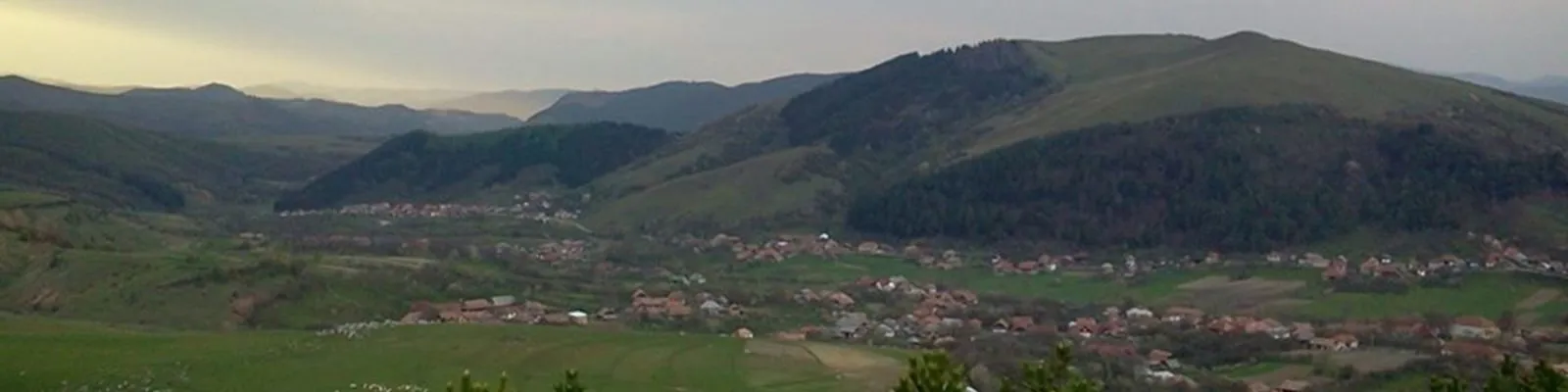
 The Roman fort of Resculum lies in the village of Bologa (Poieni commune, Cluj county), at the place called « Grădiște », very close to where the Săcuieu stream flows into the Crișul Repede river, between the villages of Bologa and Morlaca.
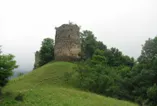
The fort was built around the year 106 as the garrison of the Second Cohort of Hispani (cohors II Hispanorum), whose task was to defend the frontier (limes) of the Roman Empire, which ran about 5 km to the west, near the village of Poieni. It is worth noting that remains of this limes can still be seen here and there: the foundations of watchtowers and stretches of earthen rampart running towards Porolissum. The ruins of the fort are still visible today, even though the area is mostly used as farmland. The earthen rampart that surrounded the fort is easy to make out with the naked eye even today, reaching a height of 3-4 m in places; still visible, too, are the defensive ditch around the fort and its entrance gates. The fort covered an area of 3 hectares and went through three main building phases and several sub-phases.
Excavations have identified the fort's fortifications (wall, ditch and earthen rampart), the gates on each side (reinforced with bastions), the two main roads, the headquarters building, the commander's residence, the supply storehouses, the soldiers' barracks and the stables for the horses (Gelu Vicențiu Olosutean - Castrul și așezarea civilă romană de la Bologa). We should also mention the existence of Roman baths outside the fort, on its northern side.
In the immediate vicinity of the fort, especially on the plateaus to its south and east, lay a civilian settlement that stretched over several hectares and was most probably called vicus Anartorum, as suggested by an inscription found on a milliarium (Roman milestone) at Almașu Mare, in Sălaj county. We should note, however, that many historians have considered the placing of the Resculum fort and the Anartorum settlement at Bologa to be, in fact, mistaken. The most important buildings of the vicus were: the baths, the mansio (travellers' inn), the temples and the forum. Its population was made up of the families of the soldiers stationed in the fort, veterans who settled in the area after their military service, and various kinds of travelling merchants and other newcomers.

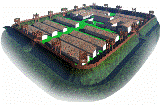
Plan of the Resculum fort and the civilian settlement (after N. Gudea, Das Römergrenzkastell von Bologa, Zalău, 1997)
Key: Rectangle - the Resculum fort; *** - the vicus; +++ - the cemetery.
The most important event in the life of the fort was the visit of Emperor Antoninus - Marcus Aurelius Severus Antoninus Augustus - also known as Caracalla, sometime between 213 and 214.
Why is it worth seeing?
- Because it is the oldest Roman settlement in the area;
- Because the ruins of the fort are still visible today;
- Because the fort played an essential role in defending the frontier of the Roman Empire.
Access: by car or by public transport (bus, train). Bologa is about 60 km from Cluj-Napoca, 13 km from Huedin and 4 km from Morlaca, on the road to Oradea. It is connected to the outside world by the European road E60, by national road 128, which leads south to Săcuieu, and by the railway (the village has its own CFR railway halt: "Bologa").
Find out more
- To see a 3D reconstruction of the fort: http://romaniaforum.info
- We recommend: http://revistaglasul.wordpress.com
0 comments